An aerial change caption describes what happened between two images of the same place taken at different dates. In FOTBCD-CC, I trained a model to write these descriptions, then used it to annotate a large collection of before-and-after imagery.
The project developed in two stages. First, a large model, Qwen3.8-Max, generated captions for roughly 20,000 selected image pairs. I used those responses to fine-tune a smaller model, Qwen3-VL-8B. That smaller model then processed the full collection of 223,675 pairs, producing the 321,200 captions analysed here. In this approach, the larger model is the teacher and the smaller trained model is the student.
I analysed the collection to answer two questions: did every pair receive a structurally usable annotation, and what do the generated descriptions contain? Whether each description is visually correct is a third question that requires inspection of the imagery; corpus statistics alone cannot answer it.
Two datasets with different roles
The teacher dataset contains 19,997 pairs and 29,447 captions from the selected 20,000-pair sample. Its purpose was to teach the smaller model how to make change decisions and write descriptions. The distillation article explains that training process.
The trained student model generated the larger dataset, comprising 447,350 images. All statistics below describe its outputs across the full collection, rather than the teacher’s training examples.
Each output includes a decision about durable change: a lasting physical alteration such as construction, demolition, paving, or permanent land conversion. Seasonal crop appearance, shadows, and temporary objects do not establish such a change. When no durable change is identified, the model writes a scene description instead.
| Full student-generated dataset | Count |
|---|---|
| Temporal pairs | 223,675 |
| Captions | 321,200 |
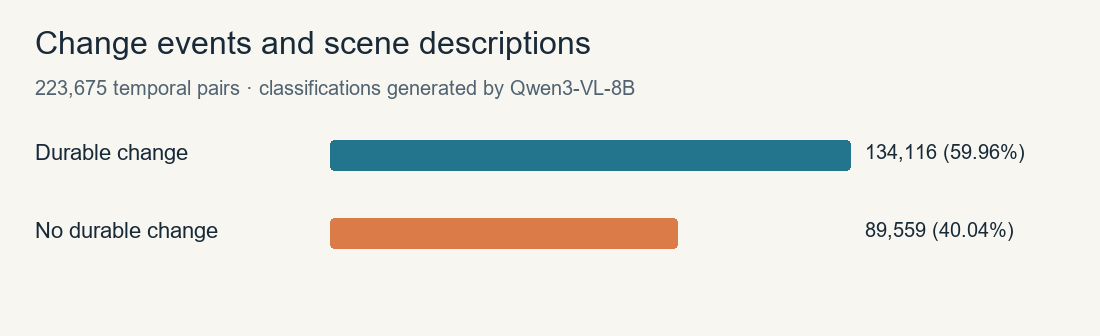
| Pairs classified as durable change | 134,116 |
| Pairs classified as no durable change | 89,559 |
| Captions attached to changed pairs | 231,640 |
| Scene captions attached to no-change pairs | 89,560 |
Every pair has a successful, parseable JSON annotation, and pair identifiers are unique. That establishes coverage and structural integrity; assessing whether a caption is visually correct requires looking at its imagery.
A change dataset also contains scene descriptions
Each output stores that decision in a durable_change boolean and the descriptions in a captions list.
The student classified 59.96% of pairs as showing durable change and 40.04% as showing none.
A no-change decision does not produce an empty annotation. The model describes the scene instead. This is an actual student response:
{
  "durable_change": false,
  "captions": [
    "Diagonal parallel furrows traverse a large cultivated field that meets a grassy margin along one side."
  ]
}
That sentence describes land cover and a spatial relationship even though it reports no event. Keeping these descriptions makes the collection useful for scene understanding and other image–language tasks alongside change captioning.
Dataset contents and retrieval training have different roles here. The dataset stores the generated scene caption. When training the model that searches image pairs from text, I do not use that scene caption as the matching text for a no-change pair. I instead use the shared sentence No durable physical change occurred between the observations. This gives change retrieval an explicit no-change target while preserving the scene descriptions for other uses.
Several events can happen at one location
Forcing each pair into a single caption would lose information when a development also adds access roads, paving, or changes to surrounding land. The output therefore supports multiple descriptions. Because many pairs receive several event descriptions, the total of 321,200 captions exceeds the 223,675 image pairs.
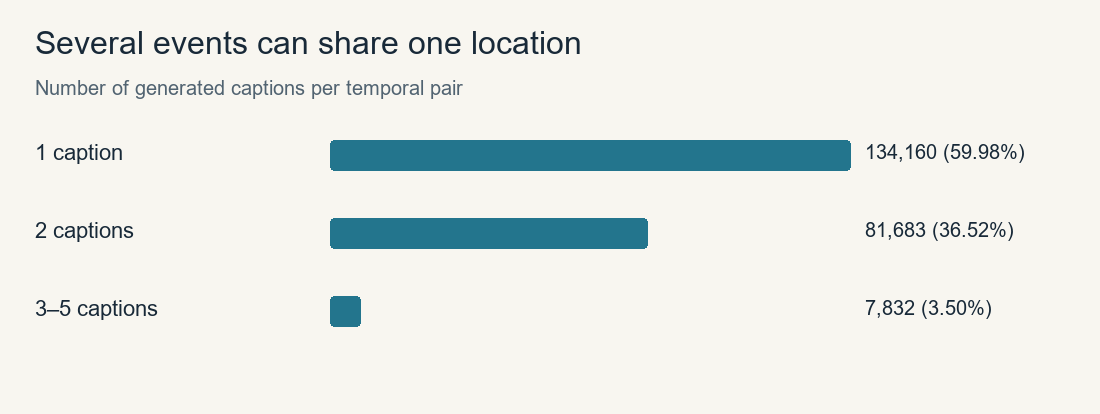
About 40% of pairs have more than one caption. Changed pairs average 1.73 descriptions, while no-change pairs almost always have one scene description. This student-generated example shows how separate sentences describe related events:
{
  "durable_change": true,
  "captions": [
    "Large buildings with reddish-brown roofs and an adjacent paved parking lot now occupy the open grassy field that previously lay between the road and the tree line.",
    "A new paved access road with marked crosswalks connects the main thoroughfare to the developed site, replacing the former unpaved ground."
  ]
}
The descriptions retain the buildings’ appearance, what occupied the site earlier, and its relationship to roads and trees. This is useful supervision for queries that combine an event with visual attributes and context. In retrieval training, I treat each event caption as a positive match for its pair.
What the language describes
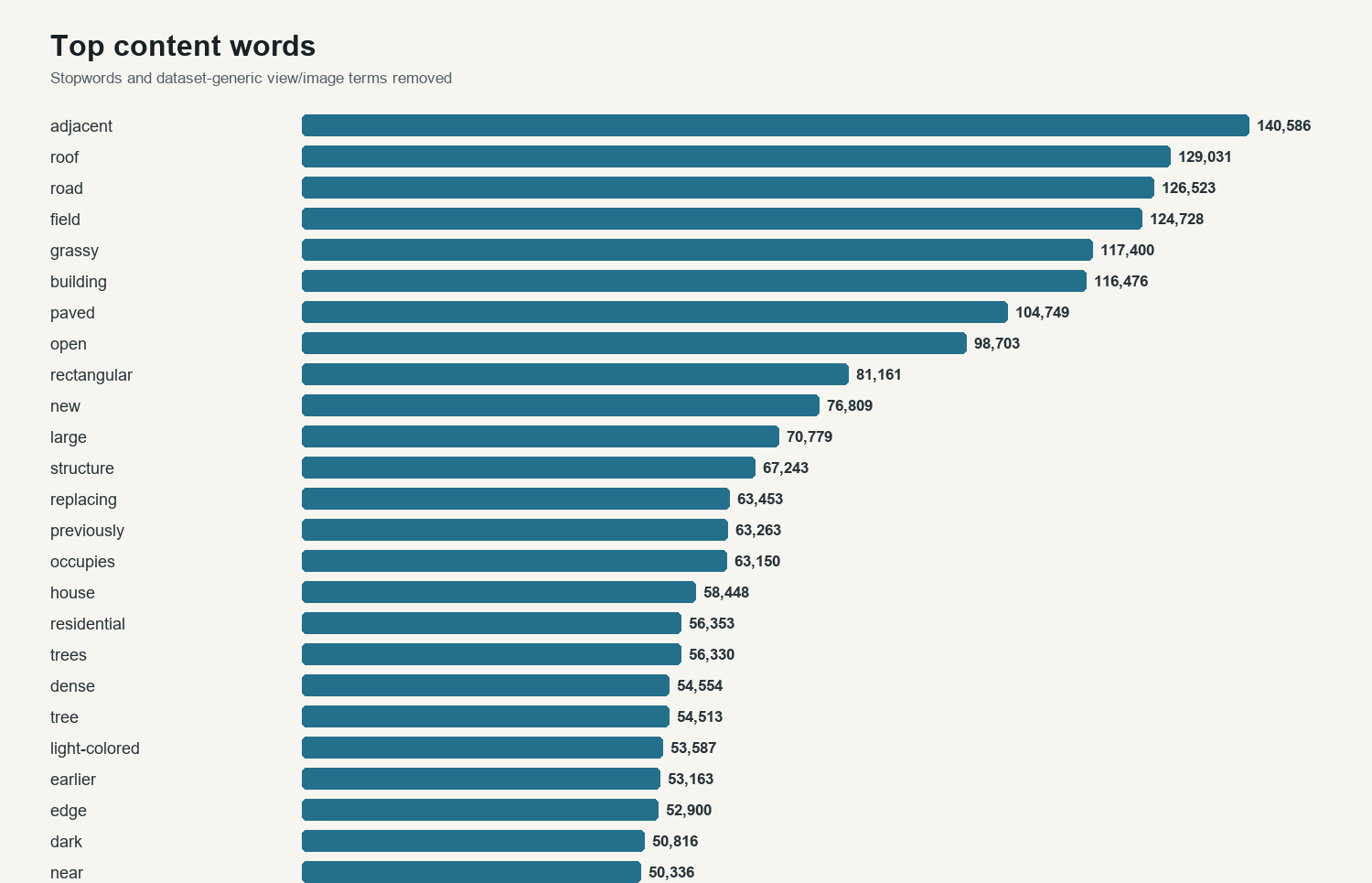
The most frequent content words include roof, road, field, building, and paved. Relational language is prominent too: adjacent is the most frequent content word, while replacing, previously, and occupies connect new features with their earlier surroundings.
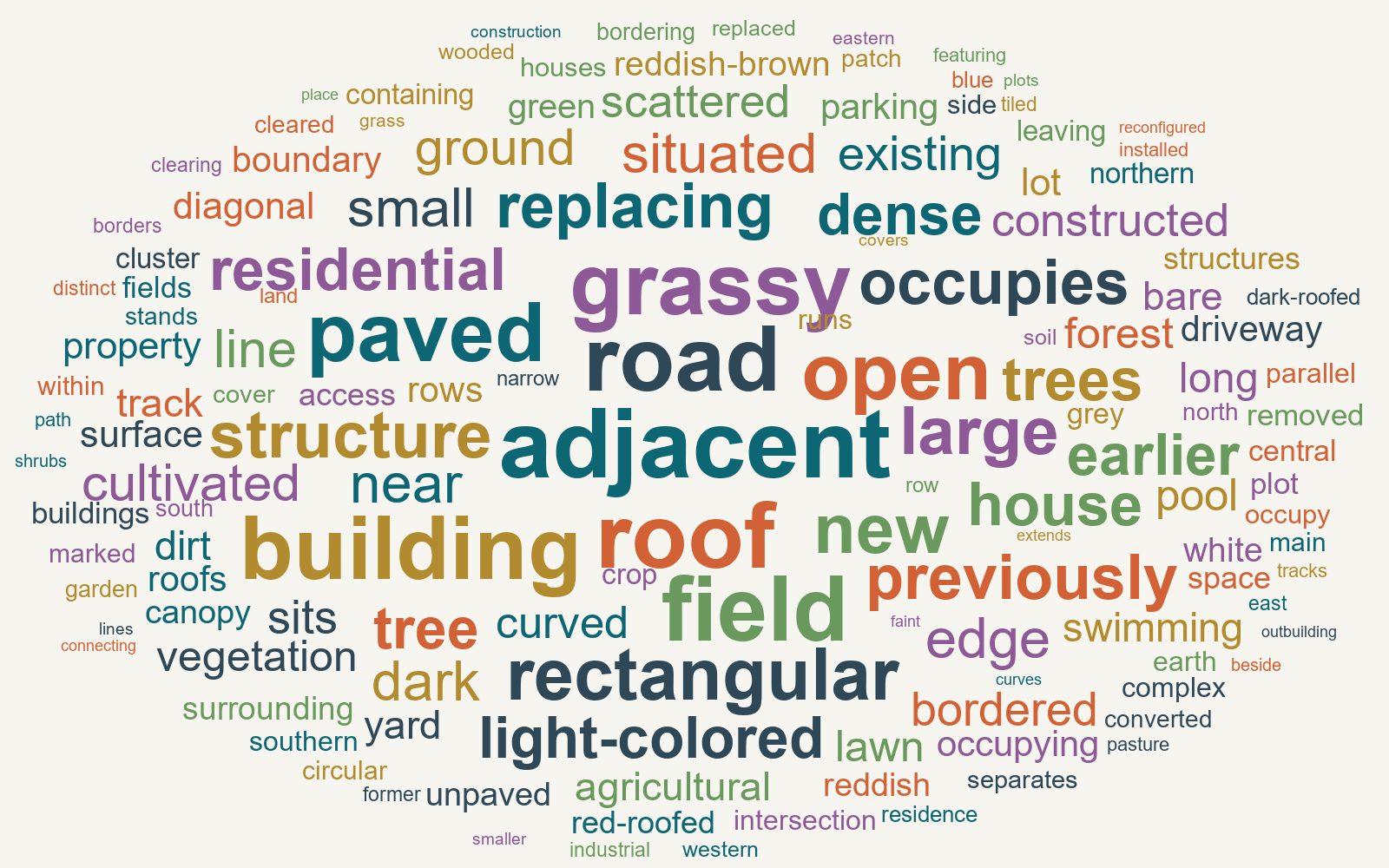
Common phrases include tree line (34,851 occurrences), paved road (32,415), and cultivated field (28,129). Those phrases help describe where an event took place, rather than simply announcing that an object appeared.
These are word and phrase frequencies, not counts of independently verified events. They reveal how the model expresses the collection, including both the imagery’s recurring features and the student’s wording preferences.
Concise descriptions, with recurring patterns
Captions average 26.13 words, with a median of 26. The fifth and ninety-fifth percentiles are 19 and 33 words. This gives most descriptions enough room to name a feature and its context without turning each annotation into a long paragraph.
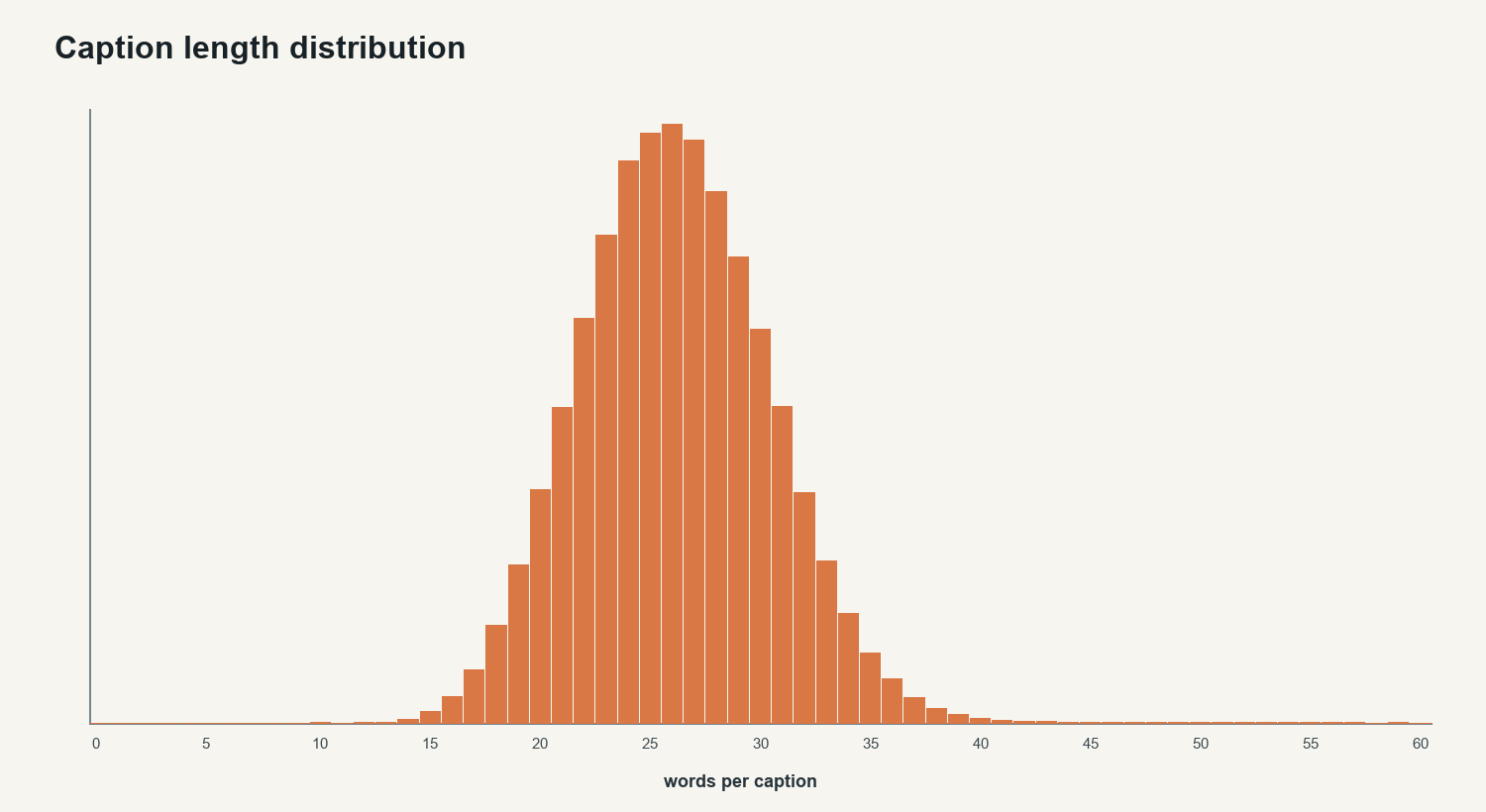
I also checked exact repetition after lowercasing and collapsing whitespace. There are 3,305 caption instances beyond the first copy of a repeated sentence, or 1.03% of the corpus. Repeated sentences often describe forest canopy, where visually similar scenes can reasonably receive similar wording.
Exact duplicates are only one part of repetition. Different sentences can still share the same opening or template, so I also examined common openings and phrases. Low exact duplication alone does not establish diverse language or correct descriptions.
Where the analysis points to further review
The source dataset also contains pre-existing building-specific change labels, separate from the generated captions. Its unchanged category refers to buildings, whereas the captioning task considers lasting changes across the whole scene.
Among pairs in that building category, 35.07% received a durable-change caption. A place can retain its buildings while adding roads or paving, or undergoing permanent vegetation clearing or land-cover conversion. Captioning errors can also produce this disagreement, so these pairs are useful candidates for visual inspection rather than automatic relabelling.
I screened wording too. Terms associated with uncertainty or alternatives occur in 2.88% of captions, and image-reference terms occur in 0.55%. These flags identify sentences to inspect; ordinary uses of or and similar words can trigger them without indicating a defect.
The export is structurally complete, and its descriptions combine events, appearance, and scene relationships. Visual review is the next step for assessing their correctness, especially where generated decisions disagree with source labels. That matters because these captions supply the learning signal for both captioning and multimodal change retrieval.