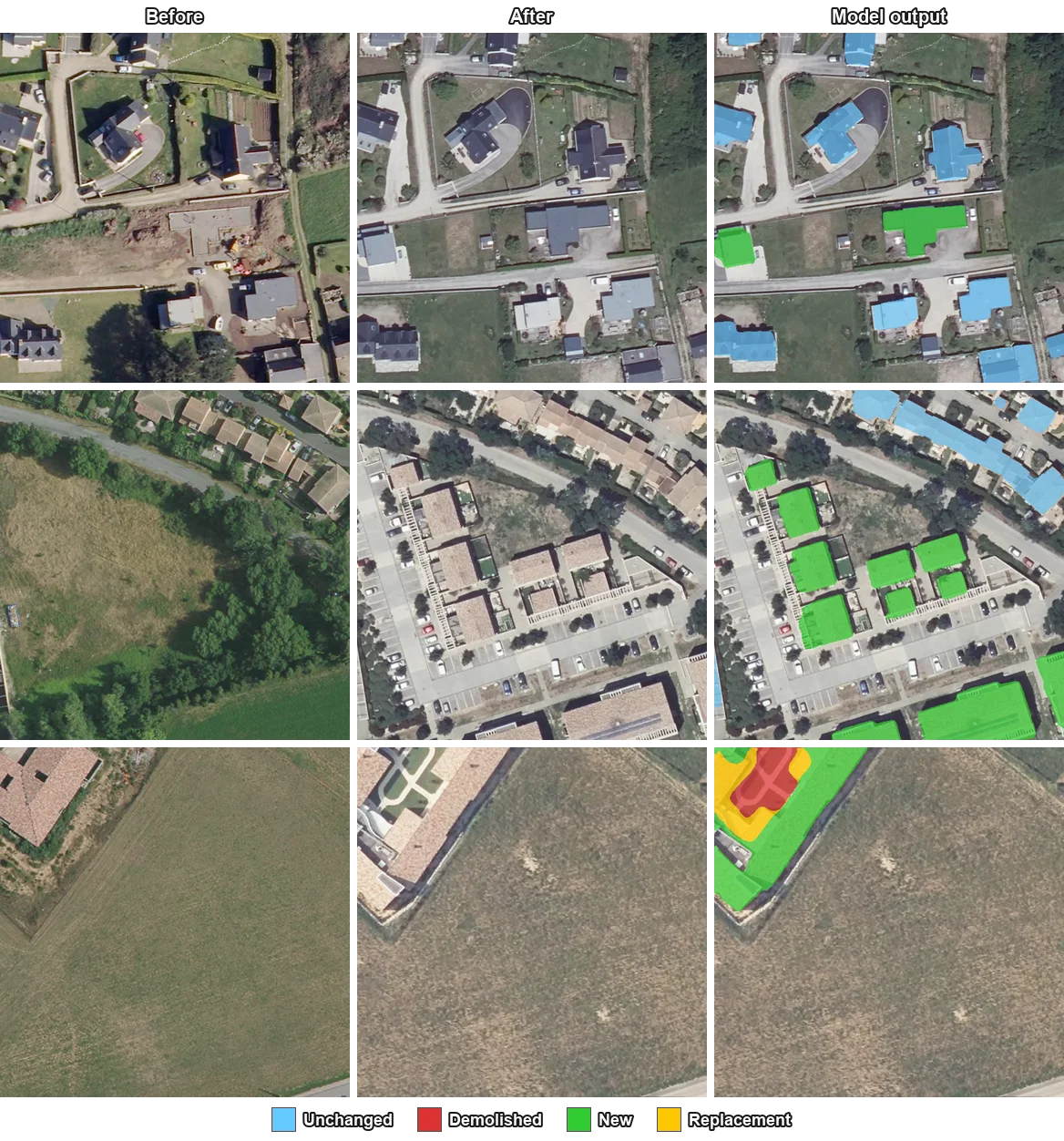
Binary change detection answers a useful first question: did something change here? For many real applications, that is only the beginning.
Imagine a before-and-after aerial pair containing a demolished warehouse, two new buildings, and cleared vegetation. A binary mask can locate the altered pixels, but it collapses three different events into the same output. The geometry survives; the meaning does not.
From detection to interpretation
Fine-grained change detection asks what kind of change occurred. That shift affects both the labels and the model. A single crop may contain several valid changes, so forcing one class per image introduces an artificial choice.
Multi-label prediction is a better fit. Each semantic label receives its own probability, allowing construction and vegetation loss to coexist. The output is more useful for inventory updates, planning, environmental monitoring, and any workflow where different changes trigger different responses.
Why this is technically harder
Meaning is less visually stable than difference. Shadows, seasons, viewing angle, and registration error can all create large pixel changes without representing the event of interest. Meanwhile, a new roof or a small demolition may occupy only a fraction of the crop.
Three design choices matter:
- A clear taxonomy. Labels need to be distinct enough to be useful and consistent enough to annotate.
- Temporal reasoning. The model must compare both dates instead of classifying the final image alone.
- Per-class evaluation. Aggregate accuracy can hide poor performance on rare but important events.
The FOTBCD and MBCTD direction
FOTBCD provides a benchmark for studying semantic change beyond a binary mask. MBCTD explores a multi-label model built for scenes where several building-related transitions occur together.
Neither project makes binary change detection obsolete. Localization remains valuable, and a binary stage can be part of a larger pipeline. The point is to match the output to the decision that follows. If different kinds of change lead to different actions, the model should preserve those distinctions.
What comes next
Fixed taxonomies still have limits. They cannot anticipate every change an analyst may want to find. That motivates FOTBCD-CC: open-ended captioning, retrieval, grounding, and example-driven mapping where language and visual evidence complement structured labels.